
 +91 98112 27269
Hearing loss is a widespread condition, yet misconceptions prevent many people from seeking timely help. Misinformation can lead to delayed treatment, social isolation, and a reduced quality of life. Let’s break some of the most common myths about hearing loss and uncover the facts behind them.

Myth #1: Many old patients buy hearing aids, but don’t use them
Fact: Since the advent of good quality digital hearing technology, patients are using their hearing aids for a good 8-12 hours a day.
Disclaimer: You need to visit a professional audiologist to get a satisfactory hearing aid fitting. A satisfactory hearing aid experience depends on a few important factors:The correct hearing thresholds should be obtained
- The correct hearing thresholds should be obtained
- The right selection of hearing aids. Hearing aids are not a one-size-fit-all.
- Selection of the right acoustic parameters
- Good programming of your hearing aids
In summary, your selection of the right hearing aid professional is critical.

Myth #2: Only Older Adults Experience Hearing Loss
Fact: While age-related hearing loss is common, hearing loss affects people of all ages, including newborns, children, and young adults. Exposure to loud noise, infections, genetic conditions, and ototoxic medications can cause hearing loss at any stage of life.
📌 Did you know?
One in five teenagers now experiences some level of mild to moderate hearing loss due to excessive use of earphones and exposure to loud sounds.
Myth #3: If You Can Hear Some Sounds, Your Hearing is Fine
Fact: Hearing loss is not always complete deafness. You might hear some sounds but struggle with understanding those sounds (in particular speech of certain frequencies where your loss is affected), especially in noisy environments. You might:
- Hear people talking but struggle to understand words
- Find it difficult to follow conversations in groups
- Have trouble hearing high-frequency sounds like birds children or female voices
🔍 Early diagnosis is key!
A simple hearing test can help detect hearing loss even before symptoms become noticeable. Adults over the age of 55 should get a routine hearing test done at least once 1 year.
Myth #4: Hearing Aids Are Too Expensive for Everyone
Fact: Hearing aid technology is honestly slightly on the expensive side if you choose to go for the top-end models. However, companies today have a wide portfolio of hearing aids to select from.
Options start as low as ₹20,000 per digital hearing aid. Value for money models with good features of noise management, feedback cancellation, active directionality and localisation, rechargeability and bluetooth are now available from only ₹88,000 for a pair!
- Hearing aids are an investment in a better quality of life
- Centre for Hearing® offers payment plans and EMI options to make good hearing aids more accessible
- The cost of not treating your hearing loss can be more costly in the long run as it can be attributed to social isolation, dementia and several other issues
 Download PDF
Myth #5: Wearing Hearing Aids Will Damage My Ears
Fact: Hearing aids do not damage the ears. When fitted correctly by a trained and experienced professional, they:
- Help the brain stay stimulated by sending the signals up to your auditory cortex
- Prevent auditory deprivation, a condition where the brain forgets how to understand certain sounds that it has been deprived of for a prolonged period of time
- Can safely amplify soft sounds to make them audible, and loud sounds are not over-amplified but only managed as per the hearing loss of the patient
🔍 Questions about hearing aids?
Consult our experts at Centre for Hearing® for professional guidance on next steps.
Myth #6: Wearing Hearing Aids with My Spectacles Will Be Difficult
Fact: Most modern hearing aids are quite small and can be worn comfortably with your spectacles. There are even styles that don’t have a part behind the ear but go deep into the ear canal, making them practically invisible.
- Small and feature-rich Receiver-in-Canal (RIC) models are now quite easily worn alongside glasses.
- Custom-molded in-the-ear (ITE) hearing aids are a great option for spectacle wearers.
Our experts can help you find the perfect fit based on your lifestyle needs.
Explore the different types of hearing aids here.
Myth #7: Hearing Loss in Children is Easy to Detect
Fact: Hearing loss in children often goes unnoticed until speech and language delays become evident. Many parents assume or are told that their child is just “taking his time” when, in reality, they might not be hearing properly.
- Newborn hearing screening at the time of birth is crucial for early detection
- Children with hearing loss may now show signs of responding to their name or or might struggle to follow verbal instructions. Further reading
- Hearing intervention in children is time critical – the sooner you act the better the outcomes will be!
Myth #8: Hearing Loss is a Minor Inconvenience, Not a Serious Health Issue
Fact: Untreated hearing loss can impact brain function, social life, and mental health. It is linked to:
- Cognitive decline and increased risk of dementia. Further reading
- Depression and anxiety due to social isolation
- Balance problems, leading to a higher risk of falls in older adults
💡 Good Hearing Health = Better Brain Health!
If you suspect hearing loss, don’t ignore it. Get your loved ones hearing tested today.
Myth #9: Hearing Aids Are Bulky, Uncomfortable, and Only for the Elderly
Fact: Modern hearing aids are discreet, lightweight, and technologically advanced. They:
- Are nearly invisible, with some models fitting inside the ear canal
- Offer Bluetooth connectivity for streaming calls and music
- Automatically adjust to different sound environments for a seamless experience
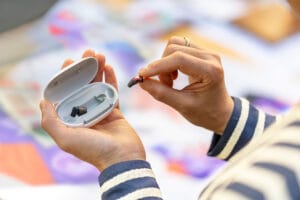
Myth #10: Wearing Two Hearing Aids is Unnecessary if I Can Manage with just One
Fact: The human brain processes sound from both ears, similar to the eyes processing vision from both eyes. Even though your hearing loss might be worse in one ear, you should consider wearing hearing aids in both ears. Ear machines in both ears:
- Help pick up sounds from both left and right sides
- Match the quality of sound coming through both ears – important for central processing
- Improve speech clarity and understanding
- Enhance directional hearing (knowing where sounds come from)
- Reduce listening fatigue by making sounds more natural
🔍 Looking for the right hearing aid?
Explore top brands like Phonak, Signia, Widex, and Oticon at Centre for Hearing®
Myth #11: Hearing Loss Can Be Cured with Home Remedies or Natural Treatments
Fact: There is no proven natural cure such as homeopathic or ayurvedic for permanent hearing loss. While lifestyle changes can help prevent further damage, audiological evaluation is important.
- Hearing aids and cochlear implants are the best solutions for managing sensorineural hearing loss effectively
- In some cases, ear infections, excessive earwax, or temporary conditions may be treated medically.
- Avoid online scams and unproven treatments that claim to “restore” hearing naturally
Take the First Step – Get Your Hearing Checked Today!
Misinformation about hearing loss can delay life-changing interventions. Don’t let myths hold you back—schedule a free hearing consultation today and take control of your hearing health.
Explore More

Get support and advice
Request an appointment
Take an online hearing test
Find a clinic near you